
AI Governance & Assurance

Before the pipeline, define the purpose

Enterprise AI can connect data across systems, but capability is not permission. A practical framework for governing what AI may know, infer, retain and act upon.

Umesh Pawar

CAPTIVOLT INSIGHTS · Published · Updated · 11 min read

AI capability does not create permission

Enterprise AI can correlate data across CRM, ERP, product usage, support interactions, documents, meetings and other systems. The more context it can assemble, the more useful the resulting signals may become.

But technical ability is not the same as organizational permission.

The important design question is not only whether the system can connect the dots. It is whether it should connect those particular dots, for that purpose, for those users, and with what consequences.

Executive summary

Many enterprise AI programs begin with data availability and model capability:

  • What information can we ingest?
  • What patterns can we detect?
  • What signals can we generate?
  • What decisions or actions can we automate?

That sequence starts too late.

Before building the pipeline, the enterprise should define the system's legitimate business purpose and the boundary of what it is permitted to know, infer, retain and act upon. Those boundaries should then follow every signal from source evidence through inference, decision and action.

My central argument is:

Responsible AI may need to start before the model, prompt or guardrail. It starts with defining the purpose and the boundary of what the system should be allowed to know.

This is not an argument against connecting enterprise data. It is an argument for making every connection purposeful, proportionate, explainable and accountable.

The problem: available data quietly becomes permitted data

An organization may have legitimate access to customer records, project documents, product telemetry, support tickets, employee communications and meeting transcripts. Once those sources are technically accessible, it is tempting to treat them as a common pool of context for AI.

That creates a dangerous shortcut:

Accessible data → available context → generated inference → operational action

Each transition can change the nature of the risk.

A support ticket may have been collected to resolve a service problem. Combining it with meeting sentiment, payment history and product activity to predict a person's reliability or future behaviour is a different use. The source records may be accurate and individually authorized, while the resulting inference is still inappropriate, excessive or outside the intended purpose.

The governance question therefore cannot end with, “Was the data legally or contractually accessible?” It must also ask:

  • Was this combination of data within the defined purpose?
  • Was this inference explicitly permitted?
  • Is the signal necessary and proportionate to the business outcome?
  • Who may see it?
  • What decision may it influence?
  • Can the affected person challenge or correct it where appropriate?
  • When must the signal be reviewed, refreshed or deleted?

Privacy risk can arise not only from unauthorized access, but also from authorized processing that creates adverse effects for people. NIST's Privacy Framework makes this distinction explicit by treating privacy as an enterprise risk arising from data processing across the lifecycle, not simply as a data-security problem.
The thesis: define a purpose boundary before designing the system

A purpose statement should not be a paragraph added to a governance document after the architecture is complete. It should be an executable design constraint.

For an AI capability that extracts business signals, I would expect the boundary to answer four questions before ingestion begins:

  1. 01

    What may the system know?
    The source systems, data classes, time periods and identities it may access.

  2. 02

    What may the system infer?
    The signals, classifications and predictions it is permitted to create, and those it must not create.

  3. 03

    What may the system retain?
    Whether it stores source evidence, embeddings, derived signals, scores, explanations and decision history; for how long; and under which access controls.

  4. 04

    What may the system do?
    Whether it may inform, recommend, prioritize, trigger a workflow or execute an action, and when human review is mandatory.

These four permissions form the real trust boundary of an enterprise AI system.

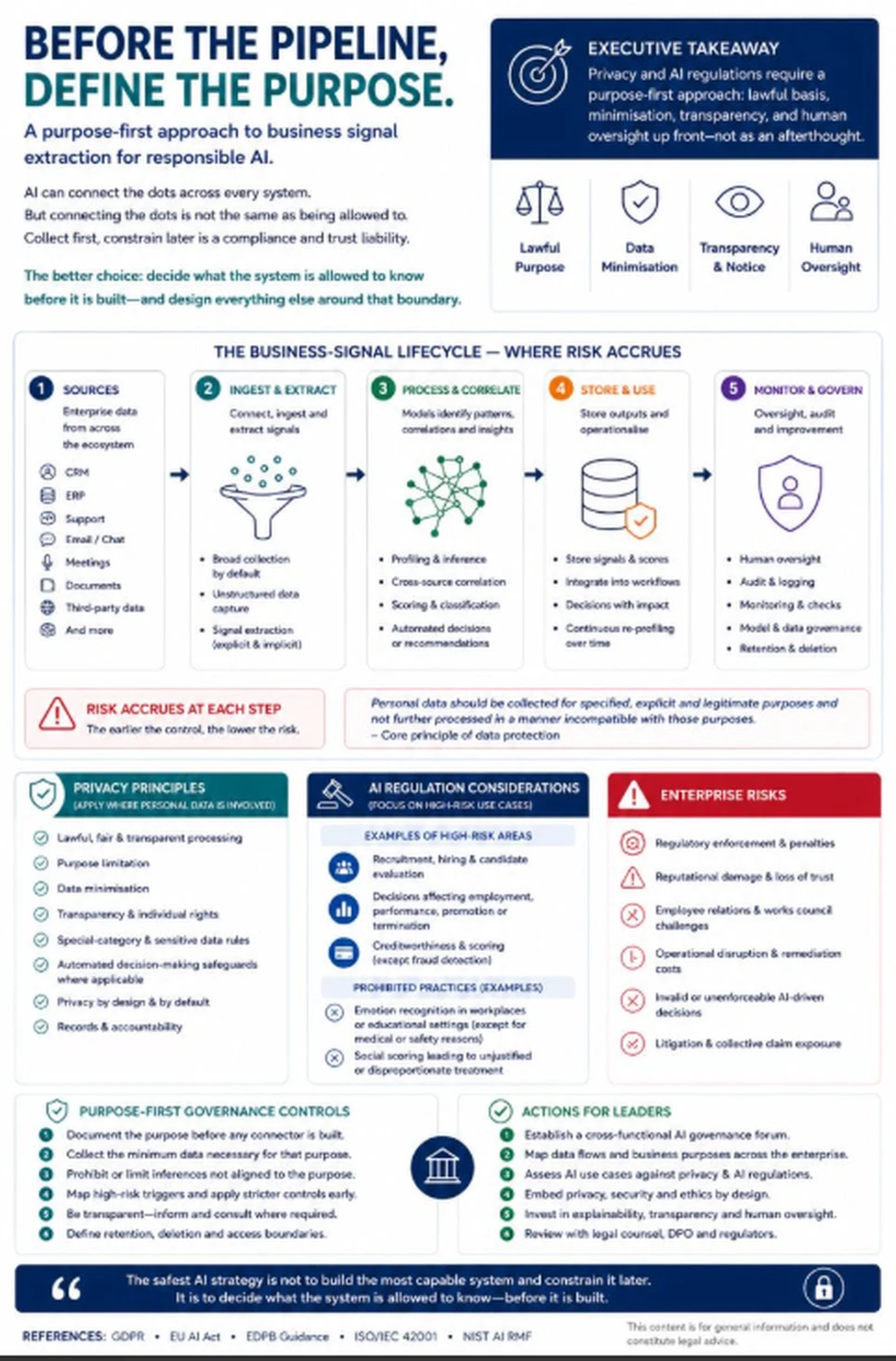
Purpose-first enterprise AI framework showing how governance should apply across data sources, signal extraction, inference, storage, action and monitoring.

The business-signal lifecycle: risk can enter when data is sourced, extracted, correlated, stored, used or monitored. The earlier the purpose boundary is defined, the less risk the organization has to contain later.

Enlarge figure
Read the figure as text

Before the pipeline, define the purpose: a purpose-first approach to business signal extraction for responsible AI. AI can connect the dots across every system, but connecting the dots is not the same as being allowed to. Collect first, constrain later is a compliance and trust liability. The better choice is to decide what the system is allowed to know before it is built, and to design everything else around that boundary.

Executive takeaway: privacy and AI regulations require a purpose-first approach, with lawful basis, minimisation, transparency and human oversight up front rather than as an afterthought. Four pillars are shown: lawful purpose, data minimisation, transparency and notice, and human oversight.

The business-signal lifecycle, where risk accrues, has five stages. Sources: enterprise data from across the ecosystem, including CRM, ERP, support, email and chat, meetings, documents, third-party data and more. Ingest and extract: broad collection by default, unstructured data capture, and signal extraction that is explicit and implicit. Process and correlate: profiling and inference, cross-source correlation, scoring and classification, and automated decisions or recommendations. Store and use: storing signals and scores, integrating them into workflows, decisions with impact, and continuous re-profiling over time. Monitor and govern: human oversight, audit and logging, monitoring and checks, model and data governance, and retention and deletion.

Risk accrues at each step: the earlier the control, the lower the risk. A quoted principle reads that personal data should be collected for specified, explicit and legitimate purposes and not further processed in a manner incompatible with those purposes, and is described as a core principle of data protection.

Privacy principles, which apply where personal data is involved: lawful, fair and transparent processing; purpose limitation; data minimisation; transparency and individual rights; special-category and sensitive data rules; automated decision-making safeguards where applicable; privacy by design and by default; and records and accountability.

AI regulation considerations focus on high-risk use cases. Examples of high-risk areas are recruitment, hiring and candidate evaluation; decisions affecting employment, performance, promotion or termination; and creditworthiness and scoring, except fraud detection. Examples of prohibited practices are emotion recognition in workplaces or educational settings, except for medical or safety reasons, and social scoring leading to unjustified or disproportionate treatment.

Enterprise risks are regulatory enforcement and penalties; reputational damage and loss of trust; employee relations and works council challenges; operational disruption and remediation costs; invalid or unenforceable AI-driven decisions; and litigation and collective claim exposure.

Purpose-first governance controls: document the purpose before any connector is built; collect the minimum data necessary for that purpose; prohibit or limit inferences not aligned to the purpose; map high-risk triggers and apply stricter controls early; be transparent, informing and consulting where required; and define retention, deletion and access boundaries.

Actions for leaders: establish a cross-functional AI governance forum; map data flows and business purposes across the enterprise; assess AI use cases against privacy and AI regulations; embed privacy, security and ethics by design; invest in explainability, transparency and human oversight; and review with legal counsel, DPO and regulators.

The closing line reads that the safest AI strategy is not to build the most capable system and constrain it later, but to decide what the system is allowed to know before it is built. The figure names GDPR, the EU AI Act, EDPB guidance, ISO/IEC 42001 and the NIST AI RMF as references, and notes that its content is for general information and does not constitute legal advice.

Going further

A purpose-first business-signal lifecycle

Purpose must persist across the full lifecycle. It cannot disappear after a data-access approval.

01 · Sources: permission to access

Document every source the AI system may use: CRM, ERP, product telemetry, support platforms, documents, meetings, email or chat, third-party data and any future source class.

For each source, establish:

  • the business purpose it supports;
  • the data owner and system owner;
  • the permitted fields and identities;
  • sensitivity and jurisdictional considerations;
  • the approved access path;
  • the intended retention period; and
  • whether the source may be combined with other sources.

This prevents “connect everything” from becoming the default architecture.

02 · Ingest and extract: permission to transform

Extraction is not neutral. Transcription, entity recognition, sentiment analysis, topic classification and embedding creation all produce new representations of source data.

The design should specify which transformations are necessary for the declared purpose. It should also distinguish between:

  • raw source content;
  • extracted facts;
  • model-generated interpretations;
  • inferred signals; and
  • confidence or uncertainty metadata.

Those categories should not be treated as interchangeable. An extracted contract date and a model-generated stakeholder-sentiment score have different evidentiary value and different potential consequences.

03 · Process and correlate: permission to infer

This is where enterprise AI creates much of its value, and where the governance boundary becomes most important.

The system may detect a correlation that no human explicitly requested. That does not mean the correlation should automatically become a business signal.

Before a candidate inference is operationalized, it should pass an inference admission test:

Admission questionRequired evidence
Does the signal serve a defined business purpose?Approved purpose and use case
Is the input data necessary and proportionate?Source-to-purpose mapping
Is the inference sufficiently valid for its intended use?Evaluation results, error analysis and limitations
Could the signal materially affect a person or business decision?Impact and risk classification
Is the signal explainable and contestable where needed?Evidence trace and review path
Is there an accountable owner?Named business and control owners

A technically interesting correlation that fails this test should remain an analytical observation (or be rejected), not silently promoted into an operational signal.

04 · Store and use: permission to retain and influence

Derived data can be more sensitive than its individual inputs. A score, classification or prediction may influence prioritization, service, employment, access, pricing, escalation or investigation.

The storage design should therefore retain more than a signal value. A governed signal record should include:

  • signal_id and signal_type;
  • purpose_id and approved use;
  • source evidence and lineage references;
  • observed_at and evidence freshness;
  • model, rule and prompt versions where relevant;
  • confidence and known limitations;
  • sensitivity and access classification;
  • permitted consumers and prohibited uses;
  • retention and expiry rules;
  • approval status; and
  • accountable owner.

This turns traceability into part of the data model rather than a reconstruction exercise after an incident.

05 · Monitor and govern: permission to continue

Approval at launch is not permanent permission.

Data changes, models drift, business processes evolve and a once-proportionate signal may acquire a new operational consequence. Monitoring should therefore cover both technical performance and continued legitimacy:

  • Is the signal still used for its approved purpose?
  • Are users interpreting it as intended?
  • Has it migrated into another workflow?
  • Are error rates uneven across relevant groups?
  • Is source evidence still current?
  • Are overrides, complaints or incidents increasing?
  • Should the signal be changed, suspended or retired?

The organization needs a mechanism to withdraw a signal, not merely improve the model that produces it.

The practical control: a Purpose-to-Action Contract

I would make the approved boundary a first-class architecture object: a Purpose-to-Action Contract.

This is not necessarily a legal contract. It is a machine-readable and human-reviewable control record that connects business intent to technical enforcement.

Contract fieldWhat it controls
Business purposeThe outcome the capability is intended to support
Allowed sourcesSystems, data classes, fields and time windows the AI may access
Allowed signalsFacts, classifications, correlations and predictions it may produce
Prohibited inferencesSensitive, speculative or out-of-scope conclusions it must not create
Permitted usersRoles that may view or use each signal
Permitted actionsInform, recommend, prioritize, trigger or execute
Human-review ruleDecisions requiring review, approval or escalation
Evidence requirementLineage, confidence, evaluation and explanation required
Retention ruleStorage, refresh, expiry and deletion requirements
OwnershipBusiness owner, data owner and privacy/risk approver
Review triggerScheduled review plus change, incident and drift triggers

The contract can then drive enforcement across connectors, retrieval filters, feature pipelines, signal registries, policy engines, agent permissions, workflow approvals, audit logs and monitoring.

In architectural terms:

Purpose → permitted sources → permitted inference → permitted audience → permitted action → accountable outcome

If that chain cannot be traced, the organization does not yet have a governed business signal. It has an inference looking for a use.

Guardrails are necessary, but they are downstream controls

Prompt rules, content filters, model policies and tool authorization matter. But they operate after important design choices may already have been made:

  • data has been connected;
  • content has been copied or embedded;
  • features have been created;
  • correlations have been computed;
  • inferred attributes have been stored; and
  • new audiences have gained access.

A guardrail may stop an agent from displaying a prohibited answer. It does not automatically justify why the data was collected, why two sources were combined or why an inference was created and retained.

Purpose-first governance does not replace runtime guardrails. It gives them something precise to enforce.

Who owns the boundary?

No single function can define this boundary alone.

  • Business owns the legitimate outcome and operational necessity.
  • Data owns source meaning, quality, lineage and access design.
  • AI and engineering own transformation, inference behaviour and technical enforcement.
  • Privacy and legal interpret applicable obligations and individual rights.
  • Risk and compliance define risk tolerance, controls and evidence expectations.
  • Security protects the data, identities, models and interfaces.
  • Operations owns how the signal is used, monitored, challenged and retired.

The decision should therefore be cross-functional, but not ownerless. Each AI use case still needs one named executive or business owner accountable for the approved purpose and consequences.

A practical governance forum can adjudicate new sources, new signal types, expanded audiences and increased action authority. Any of those changes should trigger reassessment because each can materially alter the system's purpose and impact.

What technology leaders should do

1. Require a purpose definition before approving integration

Do not approve a connector solely because a use case may eventually need the data. Require a defined outcome, permitted use and accountable owner.

2. Create a governed signal registry

Register every production signal with its definition, purpose, lineage, confidence, sensitivity, owner, consumers, action scope, retention rule and review status.

3. Separate fact, evidence and inference

Make the distinction visible in schemas, APIs and user interfaces. Users should know whether they are seeing an enterprise fact, source evidence or a model-generated conclusion.

4. Evaluate the inference, not only the model

Test whether the signal is valid, necessary, proportionate and safe for the decision it supports. Model accuracy alone does not establish appropriate use.

5. Make action authority risk-tiered

An informational signal and an autonomous action should not face the same approval threshold. Required evidence and human oversight should rise with business impact and system authority.

6. Preserve a trace from purpose to outcome

For consequential signals, retain enough evidence to answer: Why did this signal exist? What evidence produced it? Which policies applied? Who used it? What action followed? Who owned the outcome?

7. Design for revocation

The organization should be able to disable a source, prohibit an inference, restrict an audience, suspend an action or retire a signal without dismantling the entire AI platform.

The executive rule

Do not build the most capable system and constrain it later. Decide what the system is allowed to know, infer, retain and do, then build to that boundary.

The strongest enterprise AI architecture is not the one that can connect every data source. It is the one that can demonstrate why each connection exists, which inferences are permitted, how those inferences may be used and who remains accountable for the consequences.

That is how privacy and governance move from a review gate at the end of delivery into the design of the system itself.

A question for AI leaders

Who owns the boundary of what AI is allowed to infer in your organization (AI, Data, Privacy, Risk or Business), or is that ownership still unclear?


Important note

This article presents a practitioner's enterprise-architecture perspective, not legal advice. Applicable privacy, employment, sector and AI requirements vary by jurisdiction and use case. Organizations should obtain appropriate legal, privacy and regulatory guidance for their specific circumstances.

Related architecture and products

AI Quality, Governance & Security →

Discuss Your AI Initiative

About this article

Author
Umesh PawarUmesh Pawar works at the intersection of enterprise technology transformation, production-grade AI engineering, governed agentic systems and AI assurance. His focus is not simply whether AI can work, but whether it can remain useful, controlled, evidence-backed and accountable in real operating environments.
Published
· updated

Further reading

  1. NIST AI Risk Management Framework 1.0 · National Institute of Standards and TechnologyA voluntary framework organized around Govern, Map, Measure and Manage.
  2. NIST Privacy Framework · National Institute of Standards and TechnologyAn enterprise risk-management approach to privacy risk across data processing.
  3. EU General Data Protection Regulation · European UnionIncluding principles such as purpose limitation, data minimisation, transparency and accountability.
  4. European Data Protection Board guidance on automated decision-making and profiling · European Data Protection Board
  5. ISO/IEC 42001:2023 (AI management systems) · International Organization for StandardizationRequirements for establishing and continually improving an AI management system.