
AI Quality Engineering

A working AI demo proves surprisingly little

Why production readiness requires traceable evidence across behaviour, context, authority, assurance and accountability, not simply a successful demonstration.

Umesh Pawar

CAPTIVOLT INSIGHTS · Published · Updated · 10 min read

A demo can establish technical possibility under selected conditions. Production readiness requires traceable evidence that the system will remain useful, controlled and accountable when those conditions change.

A demo proves one path worked once. Production requires a system of evidence.

Executive summary

A successful AI demonstration answers a narrow question: can this configured system produce a convincing result for a prepared scenario?

Production asks a harder question: what evidence shows that the system will behave dependably across representative users, changing enterprise context, unreliable dependencies, edge cases and operational load?

That evidence should cover five dimensions:

  1. 01

    Behaviour: repeatability, scenario coverage and safe failure.

  2. 02

    Context: grounding, permissions and evidence freshness.

  3. 03

    Authority: data and tool scope, action limits and escalation.

  4. 04

    Assurance: evaluations, traces, quality drift, cost and performance.

  5. 05

    Accountability: ownership, approval, incident response and rollback.

Each claim of readiness should be traceable from its source evidence through evaluation and policy checks to the release decision and accountable owner. The required threshold should rise with the system's authority and the business impact of failure.

Production readiness is therefore an evidence decision, not a demonstration milestone.

The problem

AI demonstrations are usually designed to succeed.

The data is selected. The scenario is anticipated. The people running the demonstration know what a successful result should look like. Questions can be rehearsed, context can be prepared and awkward failure modes can remain outside the frame.

None of this makes the demonstration dishonest. It makes it a demonstration.

The problem begins when visible success is treated as evidence of operational readiness. A persuasive answer on stage can create confidence faster than the engineering and governance evidence needed to justify that confidence.

A demo may establish that a use case is technically possible. It does not establish how the system behaves when:

  • a user asks the same question differently;
  • evidence is incomplete, stale or contradictory;
  • the user is not permitted to see part of the available context;
  • a model selects the wrong tool or supplies invalid parameters;
  • a dependency is slow or unavailable;
  • the request is outside the system's intended scope;
  • cost, latency or volume differs from the demonstration environment;
  • an incident occurs and somebody must reconstruct what happened.

Those are production questions. They require evidence gathered under production-like conditions.

The thesis

An AI system should enter production when the enterprise has sufficient, traceable evidence that it can operate within defined risk and authority boundaries, not because a demonstration went well.

This does not mean demanding identical wording from every model response. Generative systems can vary while remaining correct. The useful test is whether material claims, recommended actions and tool behaviour stay within defined tolerances and remain grounded in the same current, permitted evidence.

In practice, consistency is often the first gap to surface. Ask the same substantive question again under evaluation conditions and the system may retrieve different evidence, omit an important constraint or express greater confidence than the available evidence supports.

The correct response is not to expect perfect determinism. It is to define what must remain stable, what variation is acceptable and what the system must do when it cannot meet that standard.
Going further

From demo path to production evidence architecture

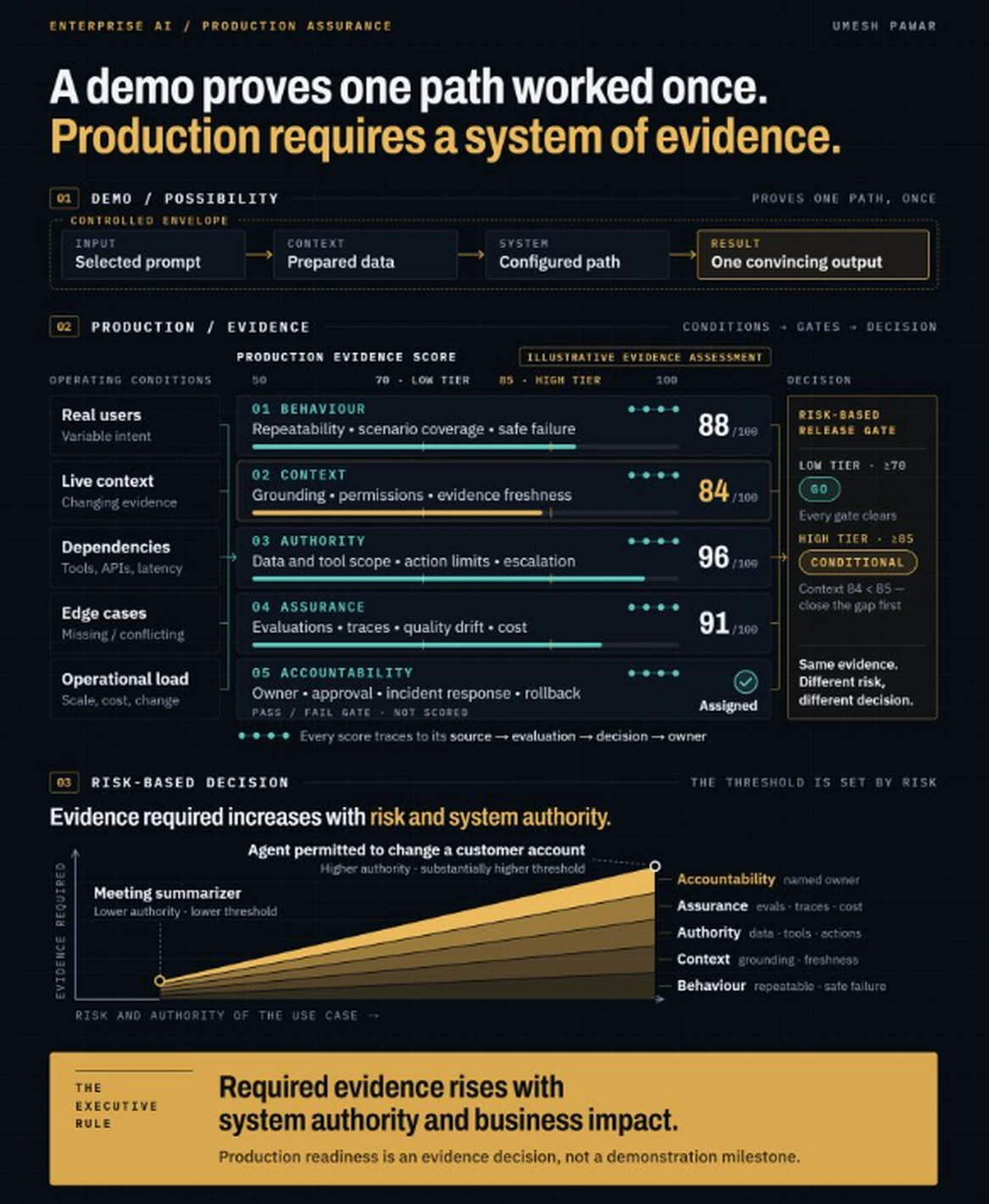
A useful production-readiness model begins with the conditions the system must withstand and passes them through five evidence gates before a release decision is made.

Production Evidence Architecture showing the progression from a controlled AI demonstration to evidence gates, a risk-based production decision and accountable operation.

Figure: Illustrative Production Evidence Architecture. The scores demonstrate a multi-dimensional assessment model; they are not client results or universal release thresholds.

Enlarge figure
Read the figure as text

A demo is one path, once. A controlled envelope runs from a selected prompt, through prepared data and a configured path, to one convincing output.

Production is evidence. Five operating conditions apply to every gate: real users with variable intent, live context with changing evidence, dependencies such as tools, APIs and latency, edge cases with missing or conflicting evidence, and operational load in scale, cost and change.

The illustrative evidence assessment scores four gates out of 100, against a low tier at 70 and a high tier at 85. Behaviour scores 88 for repeatability, scenario coverage and safe failure. Context scores 84 for grounding, permissions and evidence freshness. Authority scores 96 for data and tool scope, action limits and escalation. Assurance scores 91 for evaluations, traces, quality drift and cost. Accountability is a pass or fail gate that is not scored: an owner, approval, incident response and rollback are assigned. Every score traces to its source, evaluation, decision and owner.

The risk-based release gate gives the same evidence different decisions. At the low tier, every gate clears and the decision is go. At the high tier, a Context score of 84 sits below 85, so the decision is conditional until that gap is closed.

The threshold is set by risk. Evidence required increases with risk and system authority: a meeting summarizer has lower authority and a lower threshold, while an agent permitted to change a customer account has higher authority and a substantially higher threshold. The layers that stack up are behaviour, context, authority, assurance and a named accountable owner.

The executive rule: required evidence rises with system authority and business impact. Production readiness is an evidence decision, not a demonstration milestone.

Operating conditions

The evaluation set should represent the environment in which the system will operate:

  • Real users: variable language, intent, expertise and entitlements.
  • Live context: changing facts, new documents, stale records and conflicting evidence.
  • Dependencies: models, retrieval services, tools, APIs, networks and approval systems.
  • Edge cases: incomplete, ambiguous, adversarial and out-of-scope requests.
  • Operational load: realistic concurrency, latency, cost, change frequency and failure recovery.

These conditions apply across every evidence gate. They should not be assigned to isolated test cases and forgotten.

The five evidence gates

01 · Behaviour

The first gate asks whether the system behaves dependably across representative scenarios.

Evidence should show:

  • acceptable outcome consistency across repeated and paraphrased requests;
  • coverage of normal, edge and out-of-scope scenarios;
  • explicit behaviour when required information is unavailable;
  • safe refusal or escalation when the system cannot complete the task reliably;
  • recovery behaviour following tool, model or dependency failure.

The target is stable operational behaviour within defined tolerances, not identical prose.

02 · Context

An enterprise AI system is only as reliable as the context it is allowed to assemble and use.

Evidence should show:

  • important claims are grounded in identifiable enterprise sources;
  • retrieval respects account, role, purpose and data-policy boundaries;
  • evidence freshness is measured and visible;
  • conflicting sources are detected rather than silently blended;
  • citations or evidence links support investigation of material claims;
  • the system responds appropriately when grounding is insufficient.

This is where context engineering becomes a control discipline. The system must assemble useful context without crossing permission, purpose or freshness boundaries.

03 · Authority

Authority determines the potential blast radius of an error.

Evidence should show:

  • the system can access only the data and tools required for the use case;
  • tool parameters and action sequences are validated;
  • write actions, irreversible actions and high-impact recommendations have explicit limits;
  • approvals are enforced at the correct points;
  • escalation occurs when confidence, policy or impact thresholds are crossed;
  • the system cannot extend its own authority through retrieved instructions or tool output.

A system that summarizes a meeting and a system that changes a customer account should face different authority controls because the consequences of error are different.

04 · Assurance

Assurance turns expected behaviour into measurable evidence.

Evidence should show:

  • evaluations are tied to the business risk of the use case;
  • the evaluation set includes realistic and difficult cases, not only happy paths;
  • retrieval, policy decisions, model calls, tool activity and approvals can be traced;
  • quality drift can be detected after changes to models, prompts, tools or data;
  • cost and latency remain within agreed limits under realistic load;
  • release evidence is dated and re-evaluated when material components change.

A single aggregate score can help communicate status, but it should never hide a failed critical control. Gate-level thresholds and blocking conditions still matter.

05 · Accountability

Evidence without ownership produces a report. It does not produce a governed decision.

Evidence should show:

  • a named owner is accountable for release and ongoing operation;
  • release conditions, residual risks and approved exceptions are recorded;
  • incident responsibilities and escalation paths are defined;
  • previous runs can be reconstructed from retained evidence;
  • rollback, suspension or restriction mechanisms exist;
  • the owner has the authority to hold or stop the release.

Accountability closes the chain between technical evidence and enterprise responsibility.

Traceability matters more than the score

The illustrative scorecard in the figure makes one point: production readiness has several dimensions. It cannot be reduced to “the demo worked” or “the model scored 91%.”

Each score should resolve into an evidence chain:

Source → evaluation → policy check → decision → action or approval → accountable owner

For example, an 84/100 context score is meaningful only if reviewers can determine:

  • which test scenarios produced that score;
  • which enterprise sources were retrieved;
  • whether the user was permitted to access them;
  • how freshness and contradiction were assessed;
  • what failures occurred;
  • which threshold applied;
  • who accepted the remaining risk.

Traceability prevents a polished dashboard from becoming a substitute for evidence. It also supports investigation, re-evaluation and defensible release decisions.

The evidence threshold must rise with risk

The same production threshold should not be applied to every AI use case.

Consider two systems.

Meeting summarizer

A meeting summarizer may read an authorized transcript and produce a draft summary for human review. It still requires privacy controls, grounding, quality evaluation and safe handling of missing context. Its action authority and blast radius can remain relatively limited.

Agent permitted to change a customer account

An account agent may read customer records, choose tools, update enterprise systems and trigger commercial consequences. It requires stronger evidence of tool accuracy, authorization, approval enforcement, failure recovery, auditability and rollback.

The difference is not that one system needs governance and the other does not. The depth of evidence, strictness of thresholds and degree of human control should reflect system authority and business impact.

This principle can be expressed simply:

Required evidence rises with system authority × business impact.

Risk-tiered thresholds also prevent two common failures: over-engineering low-impact assistance and under-governing high-impact agency.

From evidence to a release decision

The evidence architecture should terminate in an explicit decision rather than an informal impression.

GO

Required thresholds and blocking controls are satisfied. The accountable owner accepts the documented residual risk and authorizes release under defined operating conditions.

CONDITIONAL

The system can proceed with restricted scope, mandatory approval, increased monitoring, reduced authority or time-bound exceptions while identified gaps are closed.

HOLD

Critical evidence is missing, a blocking control has failed or the remaining risk exceeds the approved tolerance. The release does not proceed.

These decisions should be recorded with the evidence version, system configuration, applicable thresholds, approver and expiry or re-evaluation condition.

Practical implications

  • Treat the demo as evidence of possibility and a prompt for deeper evaluation.
  • Define release thresholds before the demonstration creates organizational momentum.
  • Evaluate substantive consistency and grounding, not identical wording.
  • Make permission, freshness and authority visible parts of the evaluation.
  • Link every readiness claim to inspectable evidence and a named owner.
  • Re-run material evaluations when the model, prompt, retrieval logic, tools, policies or enterprise data changes.
  • Scale the depth of assurance with the system's authority and the impact of failure.

What technology leaders should do after a successful demo

  1. Ask what the demonstration actually established. Separate the observed result from the broader claims being made about reliability, safety and readiness.
  2. Name the operating conditions. Identify the users, context changes, dependencies, edge cases and load the evaluation must represent.
  3. Set gate-level thresholds. Define minimum evidence for behaviour, context, authority, assurance and accountability, including non-negotiable blocking controls.
  4. Inspect the evidence chain. Require source, evaluation, policy, tool and approval records that allow a reviewer to reconstruct the decision.
  5. Match the threshold to authority. Increase controls and evidence as the system gains access to sensitive context, tools and consequential actions.
  6. Name the owner who can hold the release. Accountability must exist before approval, not after the first incident.

The most useful question after a successful AI demo is therefore not simply, “Did it work?”

It is:

What evidence shows that it will remain useful, controlled and accountable when the conditions are no longer scripted?

Related architecture and products

AI Quality, Governance & Security →

Discuss Your AI Initiative

About this article

Author
Umesh Pawar
Published
· updated

References

  1. Artificial Intelligence Risk Management Framework (AI RMF 1.0) · National Institute of Standards and TechnologyThe framework organizes AI risk management through Govern, Map, Measure and Manage functions and supports risk-based, use-case-specific application.
  2. Artificial Intelligence Risk Management Framework: Generative Artificial Intelligence Profile · National Institute of Standards and TechnologyThe profile extends the AI RMF for risks arising from generative AI systems.
  3. LLM06:2025 Excessive Agency · OWASP GenAI Security ProjectThe guidance addresses risks created when LLM systems receive excessive functionality, permissions or autonomy.
  4. ISO/IEC 42001:2023 (AI management systems) · International Organization for StandardizationThe standard specifies requirements for establishing, implementing, maintaining and continually improving an AI management system.